

Product
A safety app in everyday work
A workplace safety app is a mobile tool that helps companies communicate and implement their safety practices.
Safety-App for the Workplace
A workplace safety app is a mobile tool that helps companies communicate and implement their safety practices. How does a safety app strengthen safety culture, and which functions should you expect it to provide?
A safety app in everyday work
The app is designed to bring occupational safety down to practical, day-to-day level for every employee. Whereas safety issues used to be hidden in binders and meetings, a mobile application makes sure that safety is present in real-life work situations. The app runs on a phone or tablet—exactly where the work is done, whether on a construction site, in a factory hall or in the cab of a service van.
The key is ease of use and instant usefulness. With just a few taps the user must be able to carry out the required safety actions: report a finding, run through a pre-task risk assessment, or read a safety notice. When the app truly helps work flow, it becomes a natural part of the daily routine.
Core features of a comprehensive safety app
Apps on the market differ, but a versatile safety app typically includes:
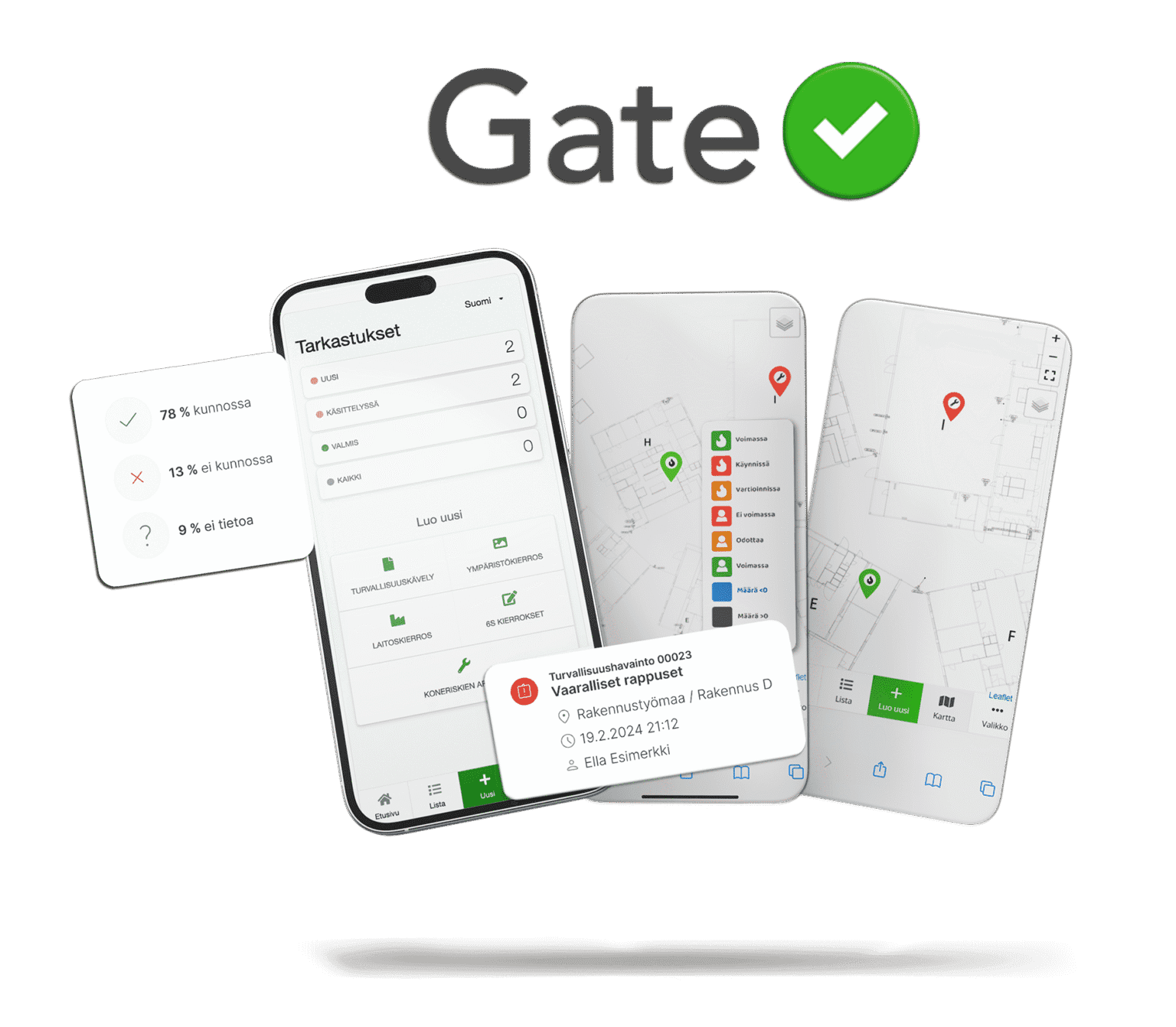
Reporting safety observations – As noted earlier, employees can at any time report hazards or improvement ideas. The interface offers predefined categories (moving machinery, fall risk, chemical safety, etc.) to simplify analysis. Photos can be attached to the report.
Accident and near-miss reporting – If something happens, information must reach the right people immediately. The app can include a form that a worker or supervisor fills in with the basic facts of an accident or near miss. This automatically triggers the background process: notifications to responsible persons, possibility to start an investigation, and so on.
On-site risk assessment – Before certain tasks (lifting operations, maintenance work, etc.) the employee should make a quick risk check. The app can supply a tool for this: a few yes/no questions or ready-made checklists such as a “5 × 5 risk matrix” or a “Take 5” safety review. The worker records observations and actions in the app before starting the job. It serves as both checklist and documentation.
Safety bulletins and instructions – Management or the safety organisation can push important notices through the app. If a new hazard is identified or a procedure changes, all users receive a notification: “New safety instruction: securing loads on trucks—please read.” This guarantees the message reaches the field instead of languishing on a noticeboard. Some apps can require a user acknowledgement that the instruction has been read.
Training and qualification tracking – The app can integrate each person’s competency data. A worker can see when their safety card or first-aid certificate expires; management gets alerts of upcoming renewals and can schedule courses in time. Mandatory e-learning modules (e.g. an annual safety refresher) can also be delivered and completion monitored.
Safety walks and audits – Supervisors and specialists can conduct safety walks with the app. A checklist for a weekly site walk-through might cover PPE use, machine guarding, housekeeping, etc.; observations are recorded directly on the mobile device and non-conformances go straight onto a corrective-action list.
Emergency functions – Some apps include features for emergencies. A single button may call for help and send the user’s location (useful for lone workers in remote areas). The app can also list critical emergency numbers and instructions—for example what to do in a chemical spill. These features provide assurance that help is always just one tap away.
Building safety culture with an app
Technology alone will not make a workplace safe, yet a well-designed safety app can be a catalyst for cultural change:
Participation – Everyone has a voice. When reporting and feedback are easy, employees become more active in improving safety. Management can use app data to reward the most active reporters or run friendly competitions (“Safety deed of the month”), creating a positive buzz around safety.
Instant feedback – Information flows both ways fast. Workers see that their observations lead to action—the app often shows status updates as issues are processed and resolved. Conversely, if someone behaves unsafely, the supervisor records a remark, discusses it and, through the app, ensures any follow-up training is completed. This constant interaction makes safety an everyday conversation.
Trend recognition – Because all safety data gathers in one cloud location, the app can compile statistics and dashboards for every organisational level. Employees might see their department’s “safety pulse”: number of observations last week, days without accidents, etc. The visibility fosters healthy competition and team spirit in improving safety.
Continuous learning – The app enables micro-learning. Short info flashes or quizzes keep knowledge fresh. Once a week the app could present a multiple-choice question on a safety topic; users answer and get immediate feedback. Regular bite-sized learning can be more effective than a once-a-year classroom course.
Case study: a safety app in action
Imagine construction company “BuildCo” using a safety app. In the morning workers complete a “daily start-up” in the app: they acknowledge the day’s message reminding them to hydrate in the heat and warning about traffic near the site. During the day an installer notices that a guard-rail on a high scaffold is loose. He snaps a photo and submits an observation; the foreman receives the alert instantly and secures the rail on the spot. In the afternoon another site has a near miss with a crane. The site manager records the event in the app on-the-spot, including a preliminary cause analysis. The HSE manager at head office sees it almost in real time and schedules an investigation meeting for the next day.
At the weekly meeting BuildCo’s management opens the app’s reporting view: observations have risen 50 % from the previous month—a good sign of rising engagement. There have been no accidents, but three crane near misses. Management decides to hold an extra crane-safety refresher for crane operators. The decision is logged as a task in the app with a responsible person and a deadline.
This example shows how the app keeps all the threads together: information flows, reactions are swift, and everything is documented. Workers say safety is now more visible—they feel free to report because it is easy and leads to thanks, not blame.
Summary: safety in your pocket
A workplace safety app boils down to one phrase: safety in your pocket. It puts critical safety tools in every employee’s hand and makes both prevention and follow-up easier. Work life is already digital; bringing safety management onto the same train is only natural.
At its best, the app is more than software—it is the organisation’s shared platform for looking after one another. Finnish, user-friendly solutions such as Gate Apps’ Safety App are tailored for Finnish workplaces, comply with national laws and standards, and have been field-tested in real operations.