

Product
What is permit-to-work management?
Permit-to-work management is the process that guarantees every permit-required job is carried out safely and efficiently.
Permit-to-Work Management
Permit-to-work management is the process that guarantees every permit-required job is carried out safely and efficiently. How should permit management be organised, what challenges does it involve, and how has digitalisation changed the way permits are handled?
What is permit-to-work management?
Permit management comprises all the actions by which a company or site plans, supervises and archives work that may only begin after an advance permit and special safety arrangements. Permit-required jobs include, for example:
Hot work (use of flame or sparks)
Confined-space work (working in tight or poorly ventilated areas)
Excavation
Work at height
Live electrical work
Maintenance tasks requiring Lockout / Tagout (LOTO)
Permit management is far more than filling in individual forms; it is a comprehensive process in which the organisation:
Defines which tasks need a permit and writes instructions for performing them safely.
Ensures that employees and supervisors recognise when a permit is required and initiate the permit process.
Appoints responsible persons who assess the risks and issue the permits.
Keeps records of every permit, its validity and its conditions.
Monitors that the work is done according to the permit conditions.
Collects the permits afterwards and analyses the data if needed (number of permits, deviations, etc.).
A well-organised system guarantees that no hazardous job “slips under the radar”: the organisation always knows when risky work is under way and whether the proper precautions are in place.
Challenges of traditional permit management
Without digital assistance, managing permits can be labour-intensive and prone to human error.
Fragmented information – If permits are handled on paper or as individual files, it is hard to see the full picture. A large plant may have dozens of permits active on the same day. Managers often use wall boards to list them, but this demands strict discipline and can fail if someone forgets an update.
Communication gaps – Permit-required work typically involves several parties: the job requester, the workers, a safety watcher, perhaps the control room, etc. With paper permits, information flow between them may falter. A classic example: a subcontractor arrives on site only to learn that the person whose signature he needs is absent, delaying the job.
Heavy follow-up workload – Permit management means tracking whether each permit has been returned, whether any breaches (work without a permit) occur, and so on. Fishing this out of paper stacks is hard. After an incident, it may be difficult to determine if a permit was valid and what it contained.
Coordination of multiple permit types – Several permit categories can run simultaneously. A welding job (hot-work permit) might take place in the same space where another team is performing electrical testing (electrical permit). Without coordination this can create new hazards—sparks and open live parts, for instance. Traditionally this relies on people’s memory and informal communication.
Staying up to date – Permits are generally time-limited (a shift or a day). One must know when they expire: will the work continue tomorrow, does the permit need renewal? Keeping track of dozens of expiring permits is tough; someone may carry on under yesterday’s permit without realising it is no longer valid.
Principles of effective permit management
To overcome these challenges, successful permit management rests on several principles:
Clear process and responsibilities – Everyone must know what to do when a permit-required job arises: who fills in the request, who approves it, how the work is supervised. Written instructions and training are essential. Management provides the framework; supervisors ensure teams follow it.
Central register – All issued permits must appear in a single, real-time register. Before digitalisation this might have been a duty log kept by the shift supervisor. Today an electronic register (at minimum a spreadsheet, preferably a dedicated system) is almost indispensable for quick sorting and sharing.
Continuous communication – Parties must stay in contact during the work. A brief “toolbox talk” before starting reviews the permit conditions and roles. Afterwards communication must remain easy—radios or agreed channels—so that changes in conditions are shared immediately. Many sites also require the watcher to inspect the area at set intervals (e.g., the hot-work fire watch does regular rounds).
Auditing and continuous improvement – The process itself must be assessed regularly. Safety staff can conduct spot checks: is any work happening without a permit? Deficiencies trigger extra training or tighter rules. Near-misses must be analysed: if a hazardous situation arose, did the risk slip through assessment or were conditions ignored? Procedures are updated accordingly.
Documentation – Completed permits need to be archived for a set period (often at least one year, sometimes longer). They may prove valuable later and are of interest to authorities or customers during audits.
How digitalisation has transformed permit management
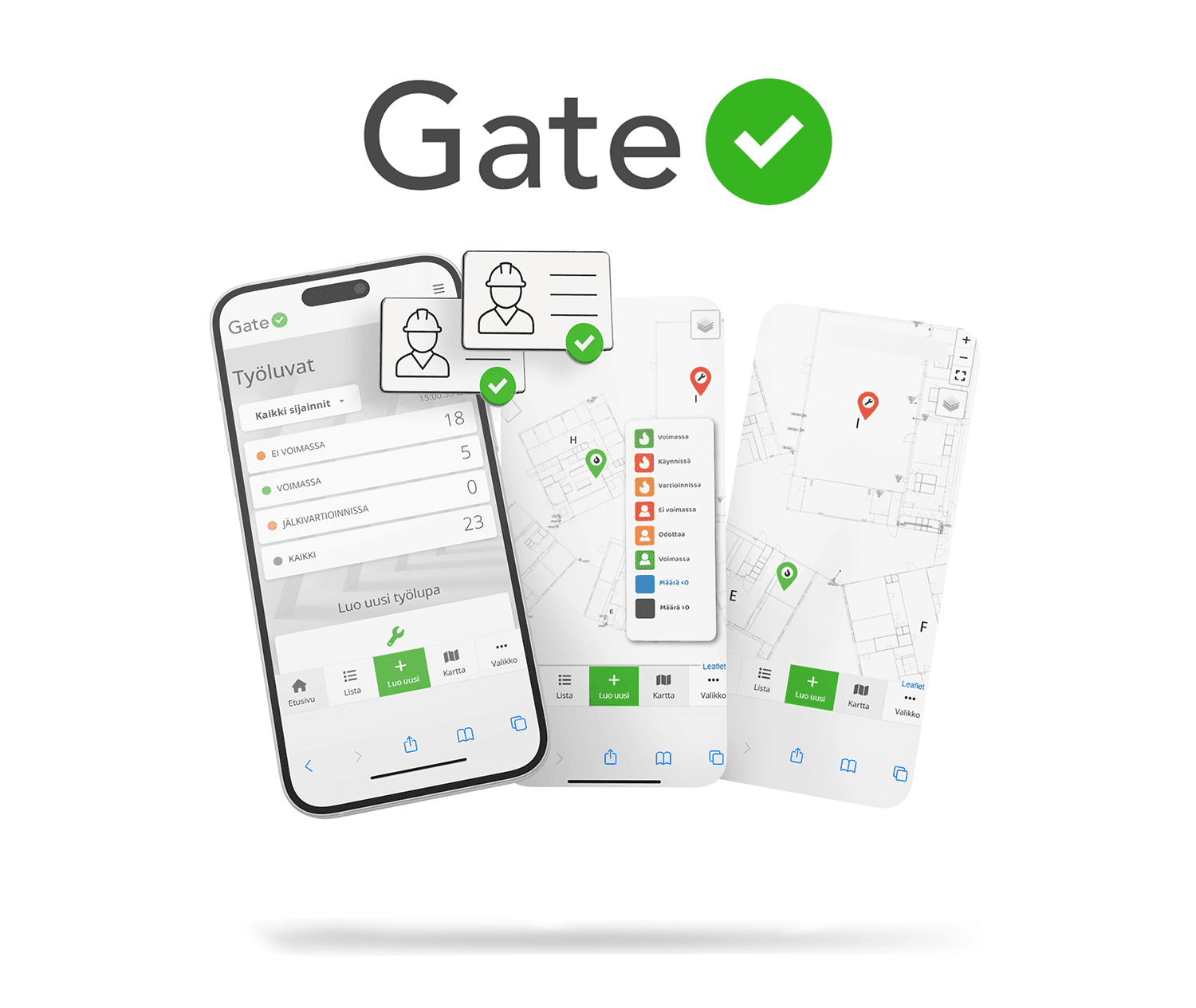
In recent years, digital permit-to-work systems (such as Gate Työluvat) have become common, fundamentally changing the game.
Real-time dashboard – The system can show all active and upcoming permits at a glance. A production manager can see from their computer how many permits are running now, how many await approval, and how many closed today. Oversight becomes proactive: an unusual spike (many permits in the same area) can be addressed by rescheduling.
Notifications and alerts – The system can flag non-compliance automatically. If work has started but the permit is not marked approved, it raises a red flag: “Job X may be under way without a valid permit!” It also reminds users when a permit nears expiry. These features prevent risks caused by forgetfulness.
Competency and training integration – Digital management can link worker data. If someone requests a permit but lacks the required training, the system warns them. Permit management thus ties into broader safety leadership: only competent personnel perform certain tasks.
Historical data analysis – With electronic data you can mine insights: number of permits over time, which job types most often need extensions, where conditions are frequently breached. This reveals improvement areas—e.g., if confined-space permits are repeatedly extended, perhaps initial time estimates are unrealistic; frequent housekeeping remarks on hot-work permits signal that cleanliness needs emphasis in training.
Multi-site management – Large companies may run several plants or projects. Digital tools enable uniform practices and information sharing across locations. Corporate HQ can access each site’s permit data; best practices can spread: if one unit excels (many observations, few breaches), others can learn from it.
Towards a safer, smoother permit process
Permit management is fundamentally human cooperation for safety. Technology supports that cooperation but does not replace common sense and skill. Even with digital tools, training and culture are vital: everyone must understand why the process exists and commit to it.
When permit control works, work becomes not only safer but more efficient. Employees realise that permit “bureaucracy” is not a hindrance; when done right it is a smooth routine that keeps hazards at bay. Acceptance rises—few oppose a system that both protects lives and saves time.
Summary: a well-controlled permit process is key to risk management
Permit-to-work management may sound like administrative overhead, yet it is an essential part of risk control at many workplaces. Done properly, it is not mere paperwork but an integral element of planning and executing tasks.
Digitalisation makes permit management real-time, transparent and analytics-driven. Companies can predict better, avoid mistakes and learn continuously. Systems such as Gate Apps’ permit-management solution are designed exactly for this: to make the permit process easy to run and supervise.
Consider your organisation’s permit practices: are they up to date? Have you ever had a “missing” permit or forgotten condition? If you want permit management accurate to the second and supportive of smooth production, modern tools are worth considering. Book a demo of Gate Apps’ permit-management system—we will gladly show how the process can remain tight yet flexible from end to end.